
The Balanced Leader
Leadership profoundly shapes workplace culture. While definitions of culture vary, it’s often about fostering respect, motivation, and enabling employees to do their best work. Companies invest billions annually in leadership development, recognizing the critical role leaders play in navigating change, from shifting regulations to evolving employee and business needs.
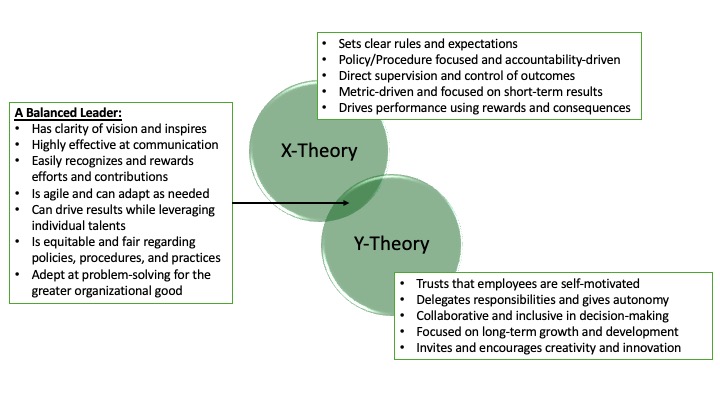
As consumer and workforce demands grow more complex, leaders must adapt. Central to this evolution is addressing leaders’ underlying beliefs about the workforce. In the 1950s, Douglas McGregor’s X-Y Theory highlighted two leadership mindsets: X-theory leaders view employees as unmotivated and require strict oversight, while Y-theory leaders see employees as self-motivated, thriving in supportive environments.
All leaders embody a mix of the two theories, heavily influenced by their learned and lived experiences. Leaders’ beliefs impact key factors such as engagement, productivity, and retention. And their approaches are instrumental in defining what professional well-being feels like, as a diverse workforce’s sense of belonging is dependent on leaders’ beliefs, thoughts, and actions.
X-theory leaders often exhibit characteristics like micromanagement, poor communication, lack of accountability, and a focus on control. While hands-on management has its place in certain situations, rigidity and distrust can harm morale and stifle talent. These managers may superficially embrace diversity but fail to foster a true sense of inclusion and belonging.
Conversely, Y-theory leaders prioritize trust, relationship-building, and growth opportunities. They embrace inclusion and belonging as drivers of success. They create a culture of respect and accountability while acting as mentors and coaches to optimize productivity and engagement. Theory Y leaders must recognize that even in complex workforce environments, talent thrives with structure and clear direction.
Even the most self-directed talent needs alignment. The leaders who understand when to guide and when to trust are the ones who build cultures where both people and performance thrive.
Here are some practical steps to take:
- Train leaders to explore and examine their thinking to better engage diverse talent, focusing on their skills, knowledge, and abilities.
- Identify and routinely discuss leadership skills that promote agile, adaptable leaders who champion thoughtfulness and have a positive impact the workplace culture.
- Equip HR partners with the skills to assess cultural dynamics and shape policies and practices that meet evolving workforce needs.
- Gather employee insights on workplace culture and what leadership can do to strengthen organizational performance.
Employees often leave leaders, not companies—and it’s usually the talent you can’t afford to lose. Adaptation isn’t optional in today’s competitive labor market; it’s essential. Are your leaders ready?